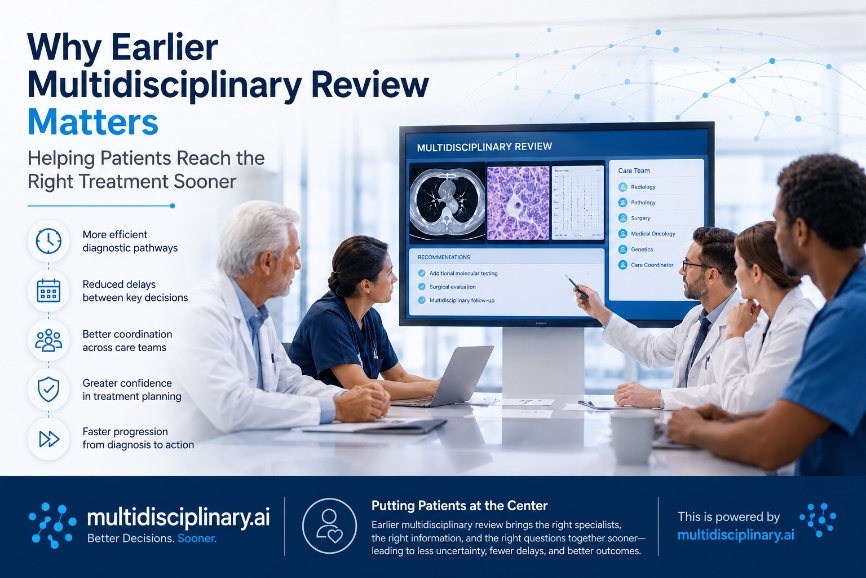
For many patients, the most difficult part of healthcare is not treatment itself—it is navigating the path to the right treatment.
A diagnosis often begins with a single test, image, or symptom. From there, patients may see multiple specialists, undergo additional testing, wait for appointments, and revisit decisions as new information emerges. Each step can introduce delays, uncertainty, and frustration.
In complex conditions such as cancer, cardiovascular disease, neurological disorders, and rare diseases, important decisions frequently depend on expertise from multiple clinical disciplines. Yet in many care journeys, those perspectives are gathered sequentially rather than collectively.
The result is a familiar experience for patients:
- Waiting weeks between specialist consultations
- Repeating the same medical history multiple times
- Receiving different recommendations from different providers
- Discovering additional tests are needed after treatment planning has already begun
- Feeling uncertain about the next step in their care journey
The Hidden Cost of Delayed Coordination
Consider a patient newly diagnosed with lung cancer. A CT scan identifies a suspicious mass. The patient meets with one specialist who recommends additional imaging. Another specialist later recommends molecular testing. A surgeon requests further evaluation. A medical oncologist wants biomarker results before discussing treatment options.
Each recommendation may be clinically appropriate. The challenge is that these decisions often occur at different points in time. What could have been identified during a coordinated review may instead unfold over multiple appointments, additional waiting periods, and repeated diagnostic cycles.
For patients, these delays create more than inconvenience. They create anxiety. Every additional week spent waiting for answers is another week wondering:
- Has the disease progressed?
- Am I receiving the right care?
- Are there treatment options we have not yet considered?
- What happens next?
Why Multidisciplinary.ai Review Changes the Process
Multidisciplinary.ai review brings together perspectives from multiple specialties before critical decisions are made. Radiologists, pathologists, surgeons, medical specialists, care coordinators, and other experts evaluate the same clinical information together rather than independently.
This collaborative approach helps identify:
- Missing diagnostic information
- Additional testing that may influence treatment selection
- Potential treatment pathways
- Clinical considerations that could otherwise be overlooked
- Opportunities to coordinate care earlier
The goal is not to replace physician judgment. The goal is to ensure that important clinical perspectives are available when decisions are being made.
Better Questions Lead to Better Care
One of the most valuable outcomes of multidisciplinary review is not necessarily finding different answers—it is asking better questions earlier. For example:
- Should molecular testing be ordered now rather than later?
- Is additional pathology review needed?
- Would another imaging study change treatment planning?
- Does the patient's overall health affect available treatment options?
- Should supportive care services be engaged sooner?
When these questions are raised earlier, patients may avoid unnecessary delays and clinicians can make more informed decisions with a more complete clinical picture.
Putting Patients at the Center
At its core, multidisciplinary review is about creating alignment.
Alignment between specialists. Alignment between evidence and clinical practice. Alignment between treatment options and patient goals.
When the right experts, information, and perspectives come together sooner, patients spend less time navigating uncertainty and more time moving forward with confidence.
Healthcare will always involve complex decisions. But patients should not have to wait for expertise to come together. Earlier multidisciplinary review helps ensure that the right conversations happen earlier—so patients can reach the right treatment path sooner.