Why Complex Patients Often Need More Than a Referral Chain
Healthcare has become increasingly specialized. For patients with complex conditions, this specialization has delivered remarkable advances in diagnosis and treatment. Yet it has also created a challenge that many patients experience firsthand: navigating a series of disconnected specialist consultations before a clear path forward emerges.
A patient may begin with a primary concern, receive a referral, undergo testing, meet with a specialist, receive another referral, and then repeat the process several times before a comprehensive treatment strategy is established.
Each step is clinically appropriate. The challenge is that each step often happens independently. The patient waits. The providers wait. Critical information arrives incrementally. And important decisions are delayed until enough perspectives have been gathered.
The problem is not a lack of specialists. The challenge is bringing the right expertise together early enough to support timely, informed clinical decisions.
The Reality Patients Experience
Consider a patient who is found to have a suspicious lung lesion during routine imaging:
- The radiologist identifies the abnormality.
- A pulmonologist recommends additional testing.
- A pathologist later reviews biopsy findings.
- A surgeon evaluates operability.
- A medical oncologist requests molecular testing before discussing treatment options.
Each specialist contributes valuable expertise. However, these evaluations frequently occur over multiple appointments spread across weeks or months. For the patient, the experience often feels very different from the clinical workflow. They are left wondering:
- Do all of my doctors see the same information?
- Are there additional tests I should have completed already?
- Why am I waiting for another appointment before the next decision can be made?
- What treatment options are actually available to me?
- Am I losing valuable time?
These concerns are not limited to oncology. Patients with cardiovascular disease, neurological disorders, autoimmune conditions, rare diseases, and other complex health challenges frequently encounter similar experiences.
The Cost of Sequential Decision-Making
Healthcare systems are designed to deliver expert care. However, expertise is often distributed across multiple disciplines. When those disciplines evaluate a case one at a time, several challenges can emerge:
- Delayed diagnostic answers. Additional testing requirements may not become apparent until later consultations, extending the diagnostic journey.
- Repeated information gathering. Patients often repeat the same history, symptoms, and concerns across multiple visits and providers.
- Fragmented clinical perspectives. Important findings from imaging, pathology, laboratory results, genetics, or treatment planning may not be reviewed collectively.
- Increased patient anxiety. Periods of uncertainty between appointments can be emotionally difficult for patients and families who are seeking answers and direction.
- Longer time to action. Treatment decisions may be postponed until all necessary information and specialist input have been gathered.
While these challenges do not occur in every case, they are common enough that many healthcare organizations have sought new approaches to bringing expertise together earlier.
The Shift Toward Multidisciplinary Deliberation
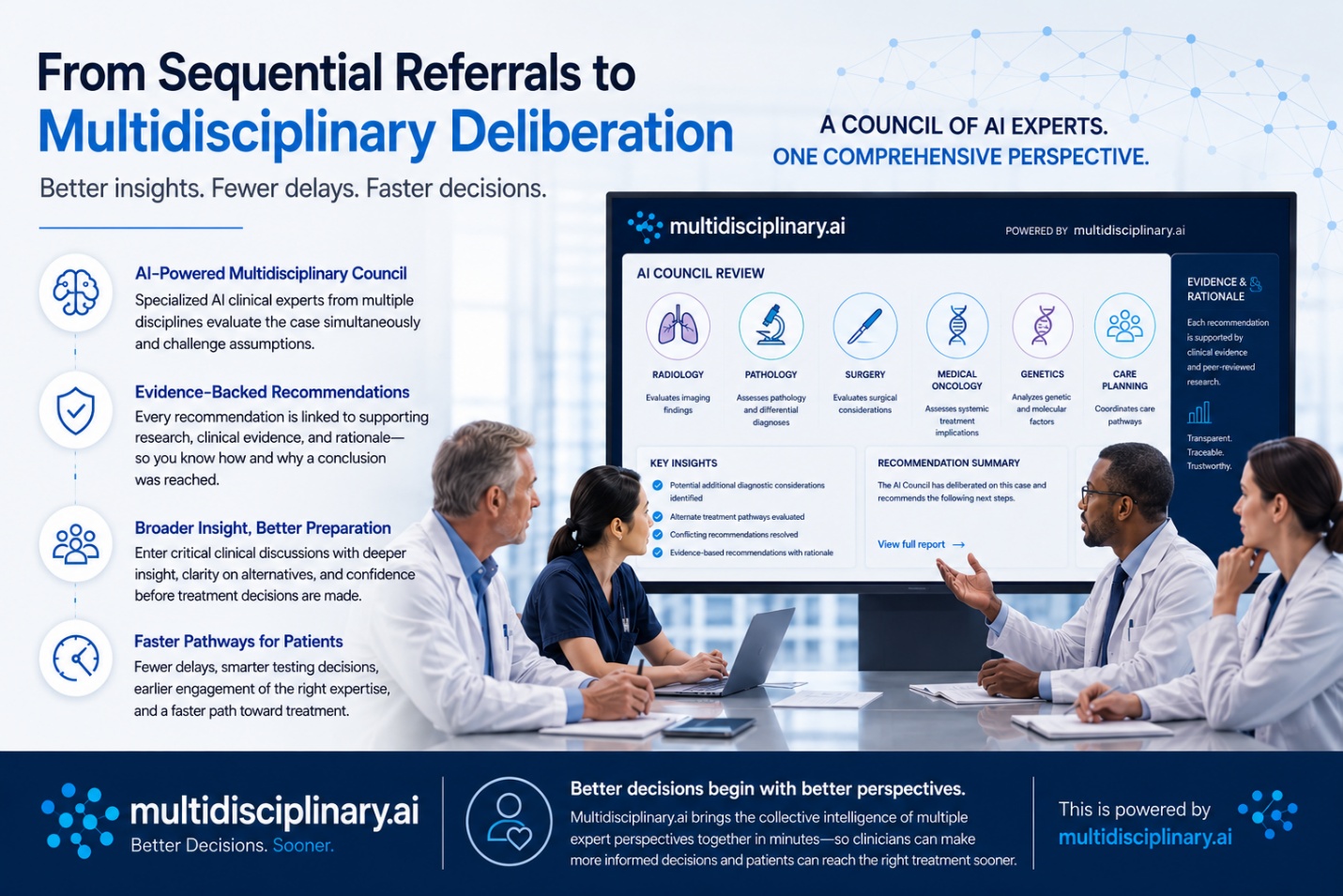
Multidisciplinary deliberation represents a different model. Rather than relying solely on sequential consultations, multiple expert perspectives are evaluated together around the same clinical question. Radiology, pathology, surgery, medical specialties, genetics, care planning, and supporting disciplines contribute their viewpoints simultaneously.
The objective is not to replace specialists. The objective is to create a more complete understanding of the patient's situation before major decisions are made. When multiple perspectives are considered together, teams can often identify:
- Additional diagnostic considerations
- Potential gaps in available information
- Alternative treatment pathways
- Clinical risks that warrant attention
- Opportunities to coordinate care more effectively
Most importantly, multidisciplinary review allows critical questions to surface earlier in the care journey.
Better Questions Lead to Better Decisions
In many complex cases, the most important clinical contribution is not a single recommendation. It is ensuring that the right questions are asked at the right time. Questions such as:
- Is additional molecular testing needed?
- Would a second pathology review provide greater clarity?
- Should another imaging study be obtained before treatment planning?
- Are there competing treatment approaches that should be considered?
- How do the patient's goals and priorities influence available options?
When these questions are addressed earlier, care teams can make decisions with a broader understanding of the patient and the evidence supporting potential pathways.
Putting Patients at the Center
Patients rarely view their healthcare journey as a collection of specialties. They view it as a single experience. They expect their providers to communicate, coordinate, and work toward a shared understanding of their condition.
Multidisciplinary deliberation supports that expectation by bringing diverse expertise together around a common goal: helping patients move from uncertainty to informed action.
The future of complex care is not simply about having access to more specialists. It is about enabling the right expertise, the right information, and the right evidence to come together sooner. When that happens, patients spend less time navigating uncertainty and more time focusing on what matters most—their health, their treatment, and their future.