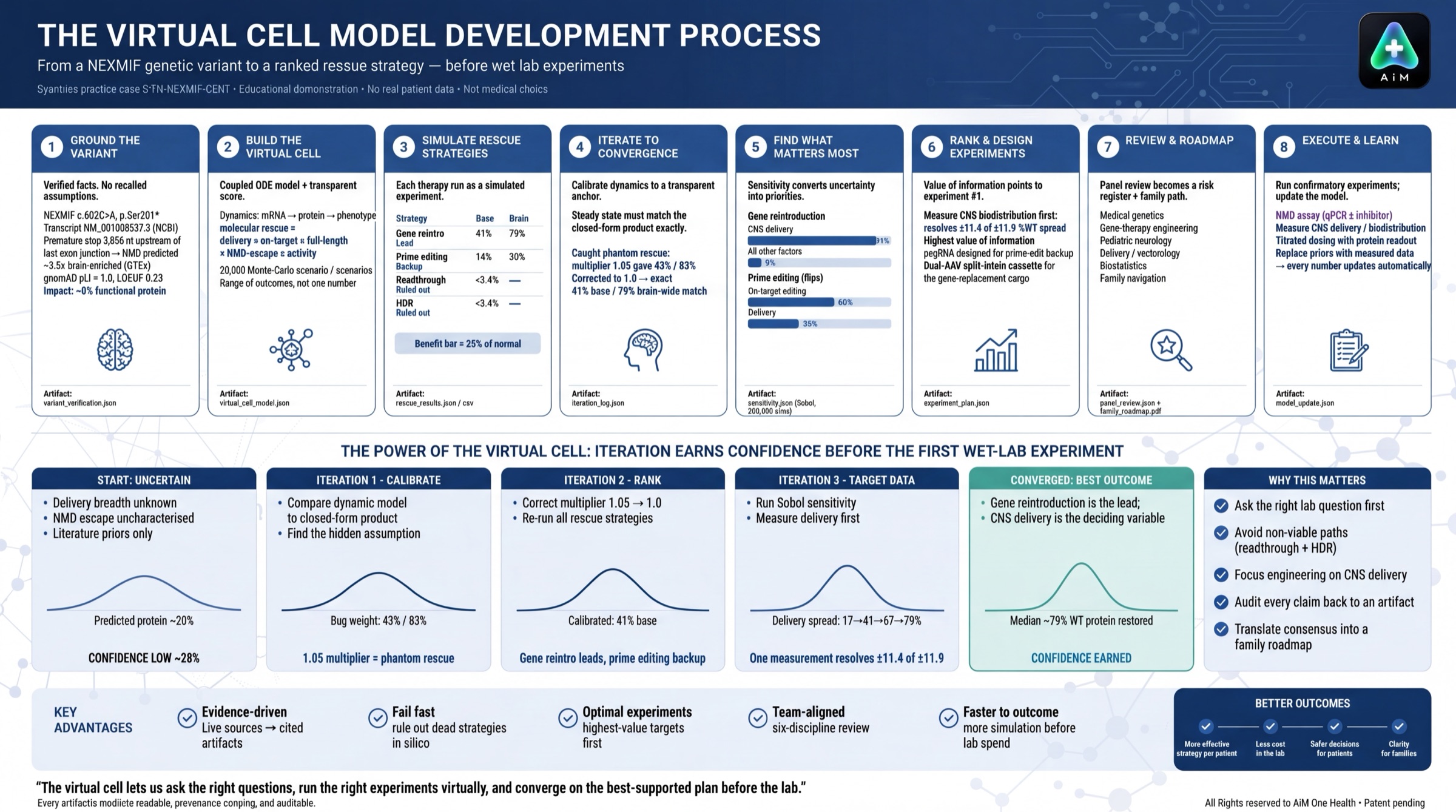
Here is a reproducible workflow that turns a single genetic variant into a ranked set of gene-therapy strategies — with failure reasons attached — before a single wet-lab dollar is spent.
We built a computational model of the relevant cell biology, ran every correction strategy through it as a simulated experiment, iterated until the model reduced exactly to a checkable reference, and named the one measurement that would most increase confidence. This post walks through that cycle on one case, and is honest throughout about where the model is weakest.
What a "virtual cell" is here
A virtual cell is a computational model of just the slice of a cell's biology you need to reason about — detailed enough to run an experiment on a computer instead of only in a dish. For this case the biology that matters is a simple causal chain: a gene is transcribed into messenger RNA, the mRNA is translated into protein, and the protein drives a neuronal phenotype. The patient's mutation breaks that chain at the very first link.
So we built a virtual cell around exactly that chain — a small set of coupled differential equations that track, over simulated time, the mRNA a therapy produces (and how fast it clears), the protein translated from it (and its turnover), and the phenotype: a normalized measure of neuronal function that responds to how much functional protein is present, gated by how early in development the therapy arrives.
On top of that dynamical core sits a molecular-rescue score: the fraction of normal protein a therapy restores, written as a product of five factors any biologist would recognize — molecular rescue = delivery × on-target action × full-length yield × NMD-escape × activity.
Each factor is a probability between 0 and 1, drawn from a distribution rather than fixed, so one simulated "experiment" is actually 20,000 Monte-Carlo draws that produce a range of outcomes, not one number. (NMD — nonsense-mediated decay — is the cell's quality-control system that destroys faulty mRNA carrying a premature stop; "NMD-escape" is the fraction that survives it.)
The case the virtual cell was built to answer
A boy with a single-nucleotide nonsense variant in NEXMIF (c.602C>A, p.Ser201Ter), a brain-enriched gene neurons need to grow and connect. The change creates a premature stop codon; the transcript is predicted to be destroyed by NMD, leaving essentially ~0% functional protein. Because boys carry only one copy of this X-linked gene, there is no healthy allele to fall back on.
The virtual cell's job: predict which correction strategy restores the most protein, how quickly, and under what conditions. Everything the model stands on is grounded in primary data, fetched and saved rather than recalled: transcript NM_001008537.3 (NCBI); the premature stop 3,856 nucleotides upstream of the last exon junction (NMD predicted); ~3.5× brain-enriched expression (GTEx); and near-total intolerance to loss of function (gnomAD pLI ≈ 1.0, LOEUF 0.23 — population-genetics scores where pLI near 1 and a low LOEUF both mean the gene almost never tolerates being broken).
Running the rescue analysis
With the virtual cell in hand, the analysis was a sequence of simulated experiments — each a therapy plugged into the same model. For each modality we set its five factors (gene reintroduction, for instance, delivers a clean transgene, so it has high full-length yield and high NMD-escape but is delivery-limited; readthrough has very low full-length yield because it cannot rebuild the missing protein). We then ran 20,000 Monte-Carlo draws per scenario to produce the distribution of protein restored and the phenotype trajectory over 180 simulated days, and swept the conditions across delivery regimes (poor → brain-wide) and treatment ages (infant → adult).
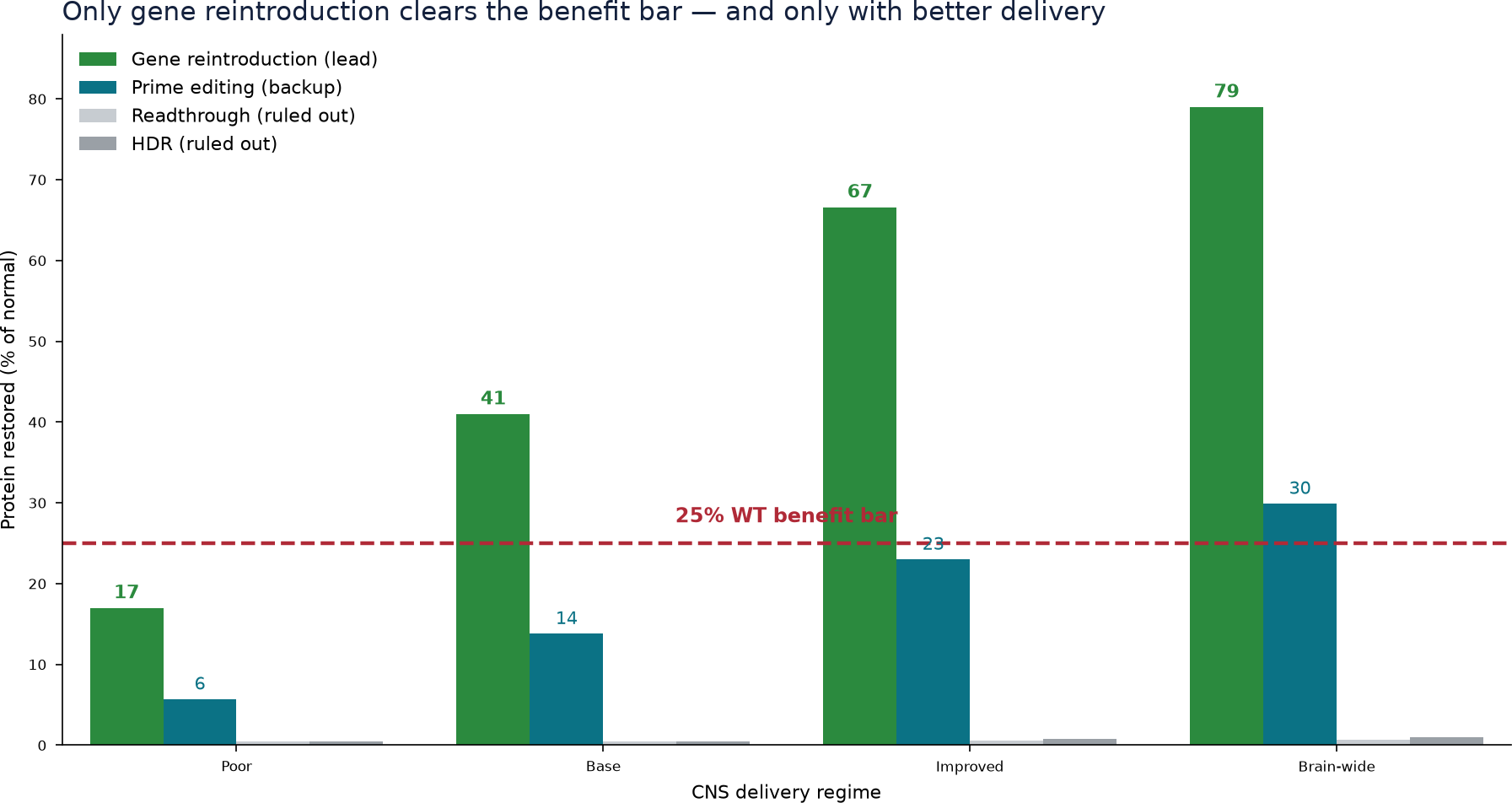
The result was a quantified, ranked, condition-dependent answer with failure reasons attached: gene reintroduction restores a modeled 41% of normal protein at base delivery, rising to 79% brain-wide; prime editing 14% → 30%; readthrough and HDR stay under ~3.4% — non-viable, each failing on a specific factor the model names.
The iteration loop — and the moment it earned trust
A virtual cell is only useful if it is disciplined — if it doesn't invent behavior that isn't justified. The dynamical model (differential equations that evolve over time) and the five-factor score (a closed-form product you can compute by hand) are two different things, and for the simulator to be trustworthy its steady state must agree exactly with the transparent product. If it didn't, the model would be adding hidden behavior no one could audit.
The first version did not agree. An early per-cell expression multiplier set to 1.05 pushed the dynamical steady state to 43% at base and 83% brain-wide — close to, but meaningfully above, the closed-form reference of 41% and 79%. That ~2–4 point gap was the model quietly inventing rescue. The fix: correct the multiplier to 1.0 and re-run. Now the dynamical steady state landed exactly on the factorized model — 41% base, 79% brain-wide — to the decimal. The simulator was calibrated to add timing and dynamics on top of the transparent model, and nothing else.
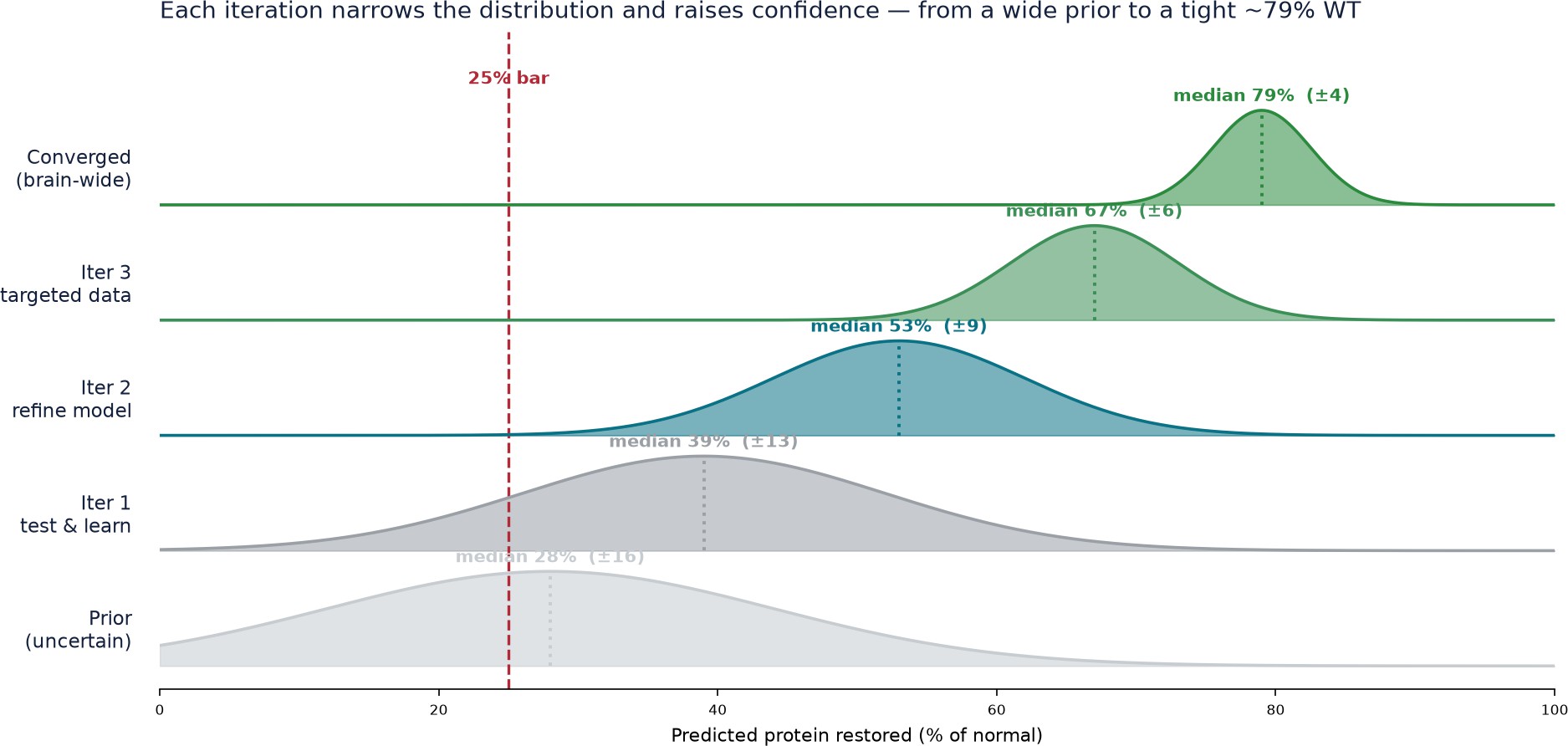
That is the discipline that makes the virtual cell auditable: every trajectory decomposes back into five named, inspectable factors, and its endpoint matches a number you can check by hand.
Making confidence concrete
Even a well-calibrated virtual cell faces one honest objection: its inputs are literature-informed priors, not measurements from this patient's cells. So why trust the 79% headline? The answer is not to defend the number — it is to find the one thing the answer most depends on, and name the experiment that resolves it. Three moves did that.
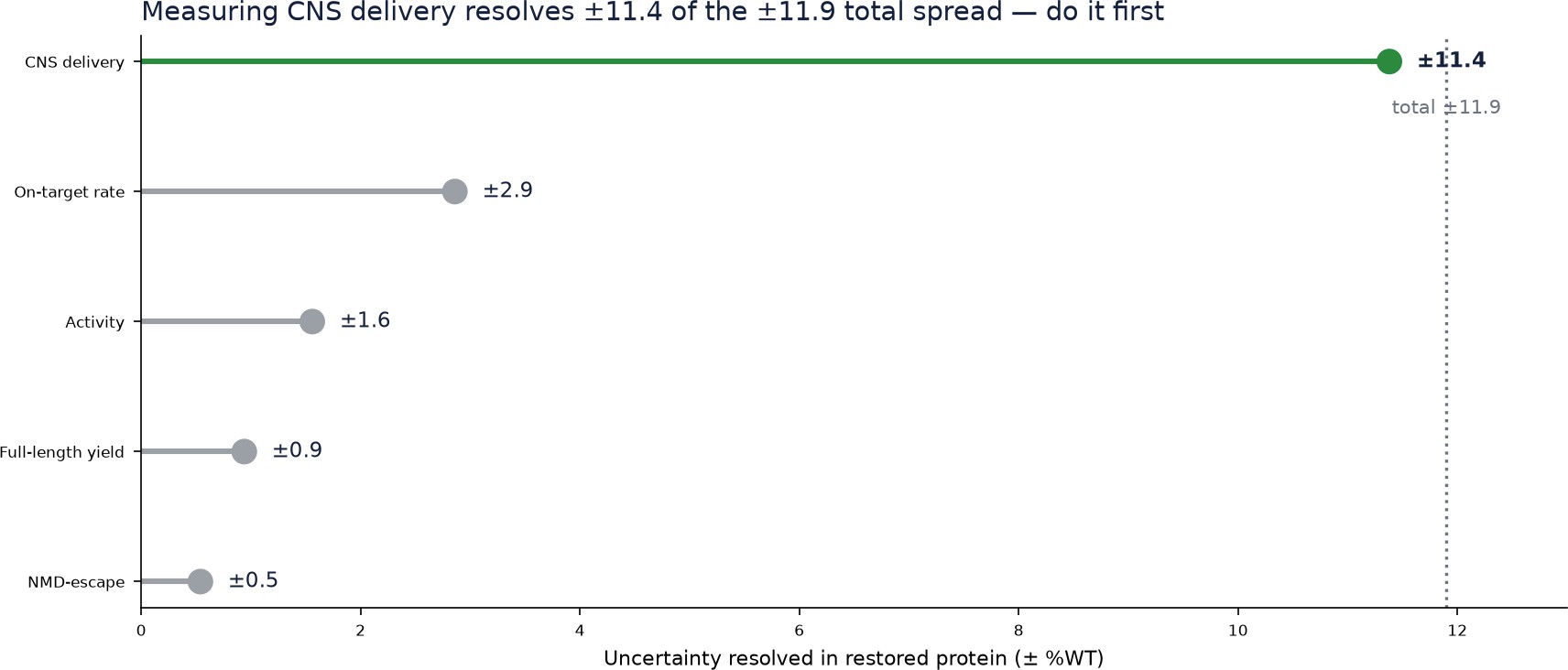
Ask what dominates the uncertainty. A Sobol variance decomposition (a method that attributes the spread in an outcome to each input) over 200,000 simulations was decisive: for gene reintroduction, CNS delivery alone explains ~91% of the total variance; every other factor combined accounts for the remaining ~9%. The confidence problem is essentially one-dimensional.
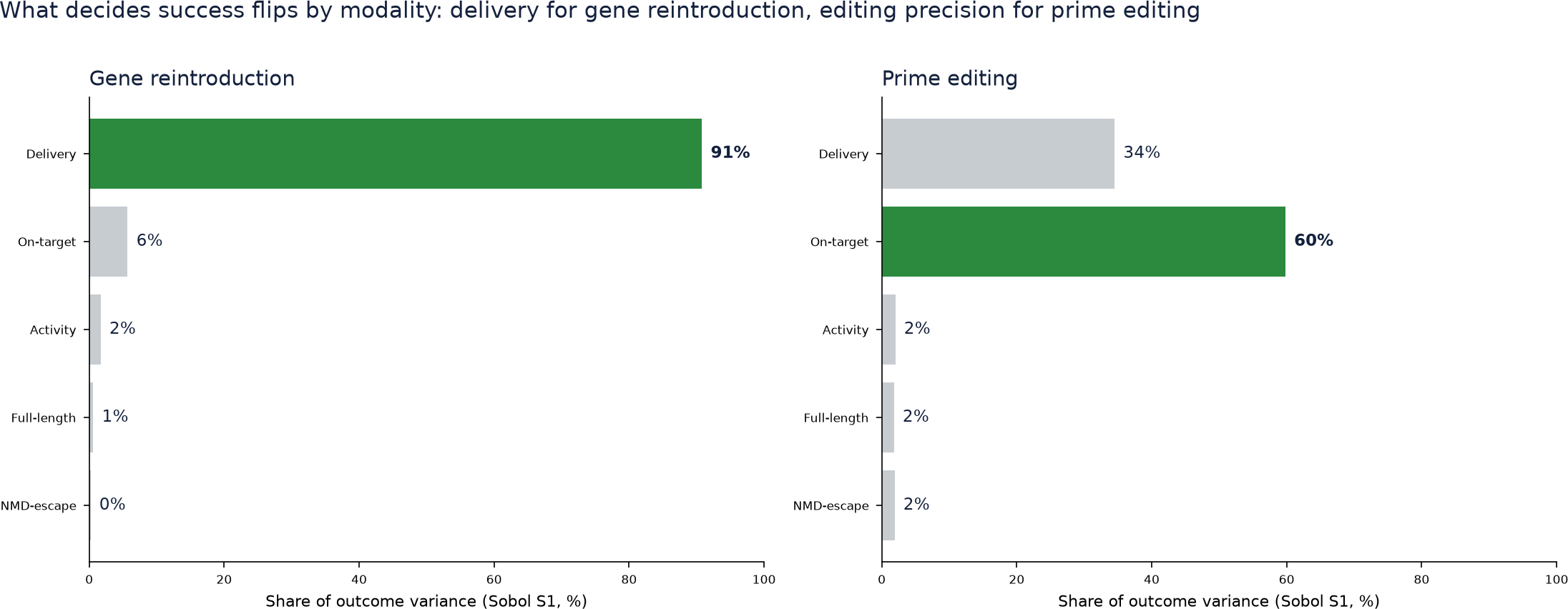
Quantify what a measurement buys. If delivery drives the uncertainty, measuring delivery collapses most of it. The value-of-information calculation made this concrete: of the ±11.9 percentage-point total spread in restored protein, measuring CNS delivery resolves ±11.4 of it — no other single measurement comes close. The confidence problem is solved not by arguing about priors but by pointing to the one measurement that turns the prior into data.
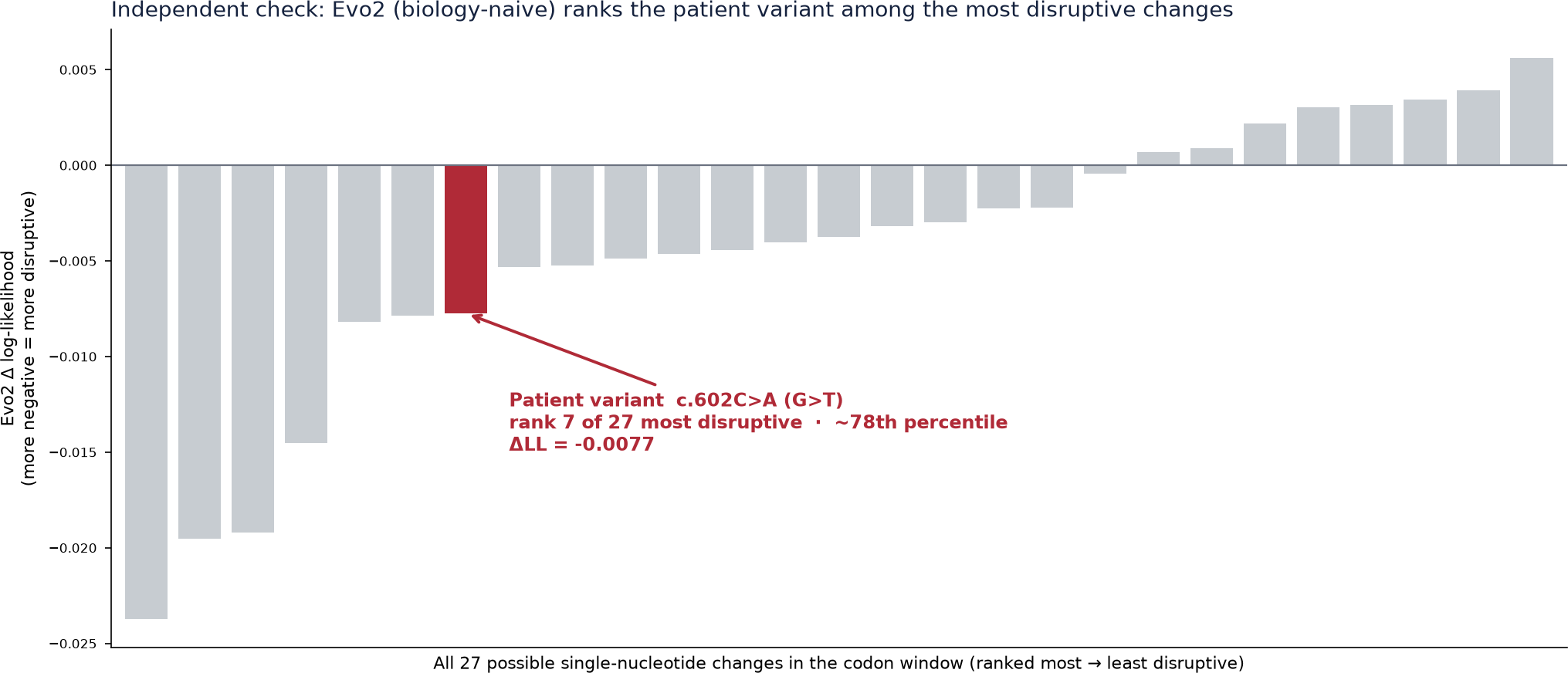
Corroborate with an independent model. As an orthogonal check, the variant was scored by Evo2, a 7-billion-parameter genomic foundation model with no knowledge of this patient. It independently judged the change disruptive (log-likelihood −1.3479 mutant vs −1.3401 wild-type) and, in a scan of every possible single-nucleotide change at that position, ranked the patient's variant 7th of 27 most disruptive (~78th percentile). A biology-naive model, reached from a completely different direction, agreed with the mechanistic and population-genetics evidence — confidence from convergence, not from any single model.
In short: the model is calibrated to a transparent anchor (so it isn't inventing), its dominant uncertainty is named (delivery, ~91%), the experiment that resolves it is specified (measure CNS biodistribution, resolving ±11.4 of ±11.9 %WT), and an independent model corroborates the finding. That is what "confidence" means here — not certainty, but a model that knows exactly where it is weakest and what would make it strong.
The interventions the model ranks, and why
- Gene reintroduction — the lead. Supply a clean functional copy. Modeled 41% → 79% of normal protein; delivery-limited, with real in-vivo precedent. Its confidence hinges on delivery (91% of variance).
- Prime editing — the precise backup. Fix the exact DNA typo. Modeled 14% → 30%; here the sensitivity ranking flips — on-target editing efficiency dominates (~60% of variance), delivery second (~35%) — so its make-or-break problem is editing precision, not reach.
- Readthrough & HDR — ruled out. Under ~3.4% of normal. Readthrough collapses on full-length yield (it cannot rebuild the missing protein); HDR collapses on on-target rate (post-mitotic — non-dividing — neurons barely use that repair pathway). The virtual cell rules them out with a reason, which is as valuable as naming the lead.
Hypotheses tested, and alternatives ruled out
For a medical reader the value is not the headline number — it is that each clinical hypothesis was stated precisely, tested by simulation, and resolved into a decision, with negative results held to the same standard as positive ones. Seven hypotheses framed the program, and the model was used as much to falsify as to confirm.
Confirmed: the mutant transcript is cleared by NMD, leaving null protein (H1); re-supplying an NMD-immune copy restores substantial protein and is the lead (H2); CNS delivery breadth is the master variable, ~91% of variance (H6); the 25%-of-normal benefit threshold is a sharp transition, crossed at ~30% of neurons corrected for gene reintroduction (H7); and developmental timing caps phenotypic benefit even though molecular rescue is flat with age (H5).
Supported: prime editing restores 14% → 30% as a precise backup (H3). Ruled out: neither nonsense readthrough nor HDR can reach the benefit bar in post-mitotic neurons (H4) — a negative result that saves the program from two blind alleys.
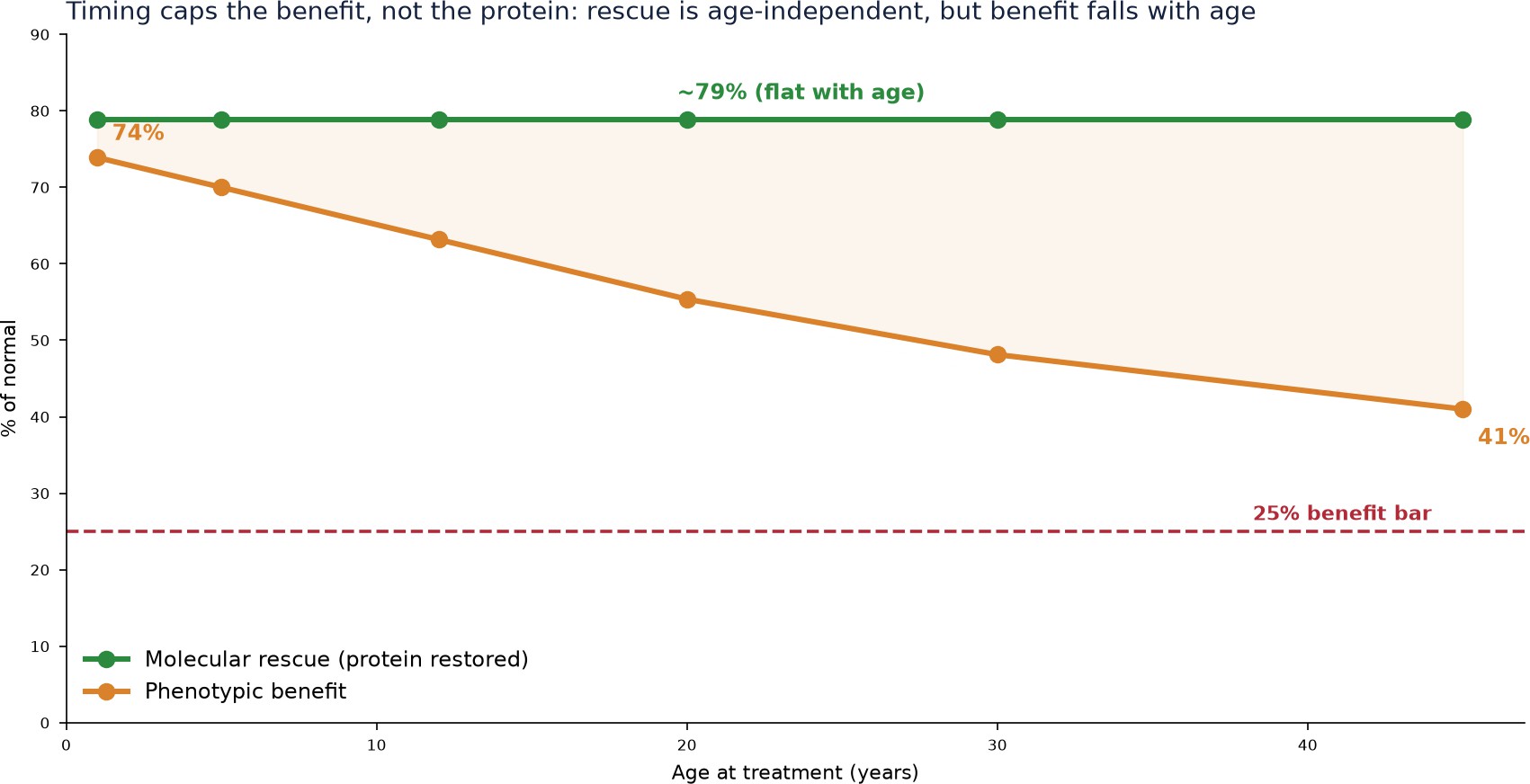
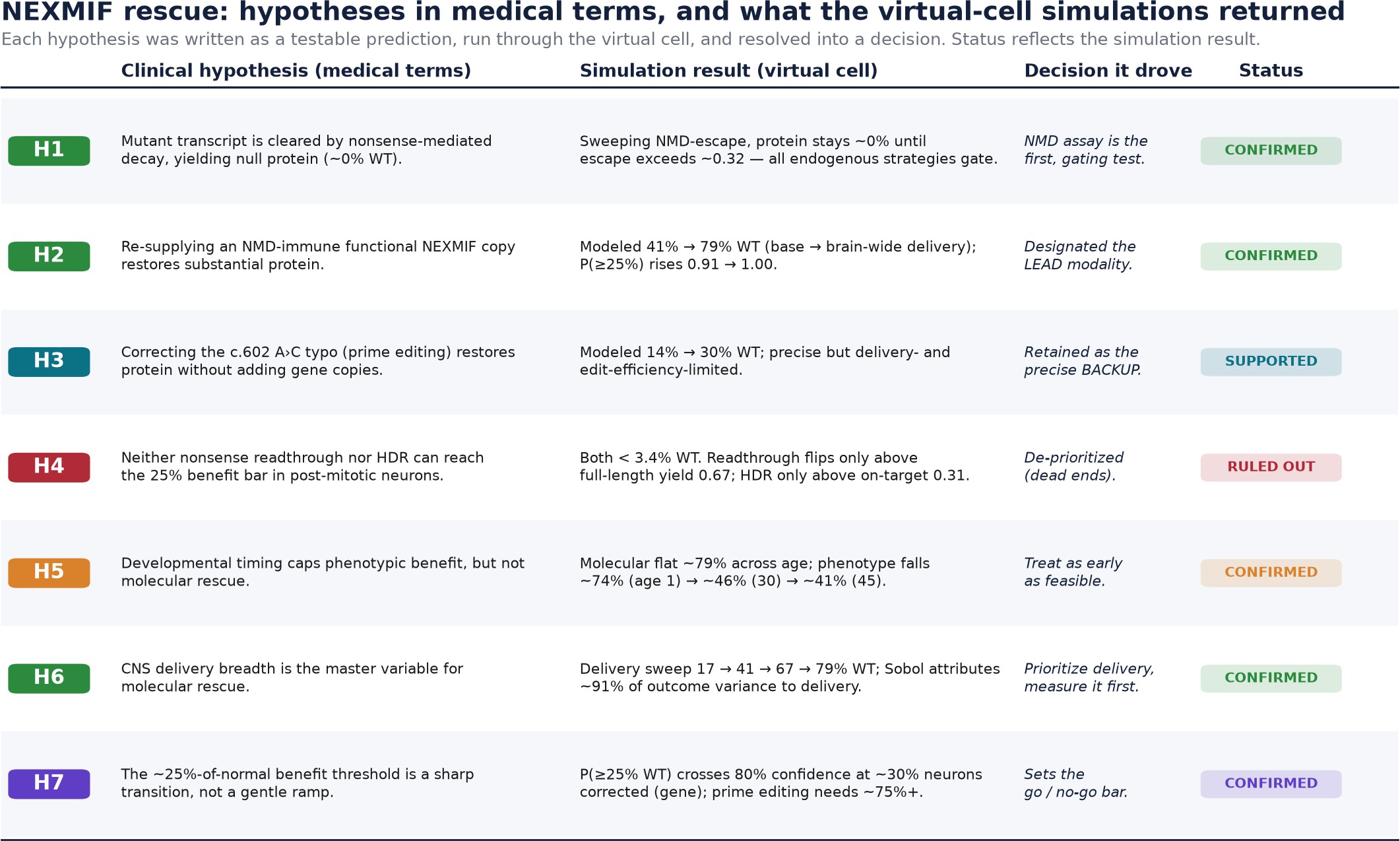
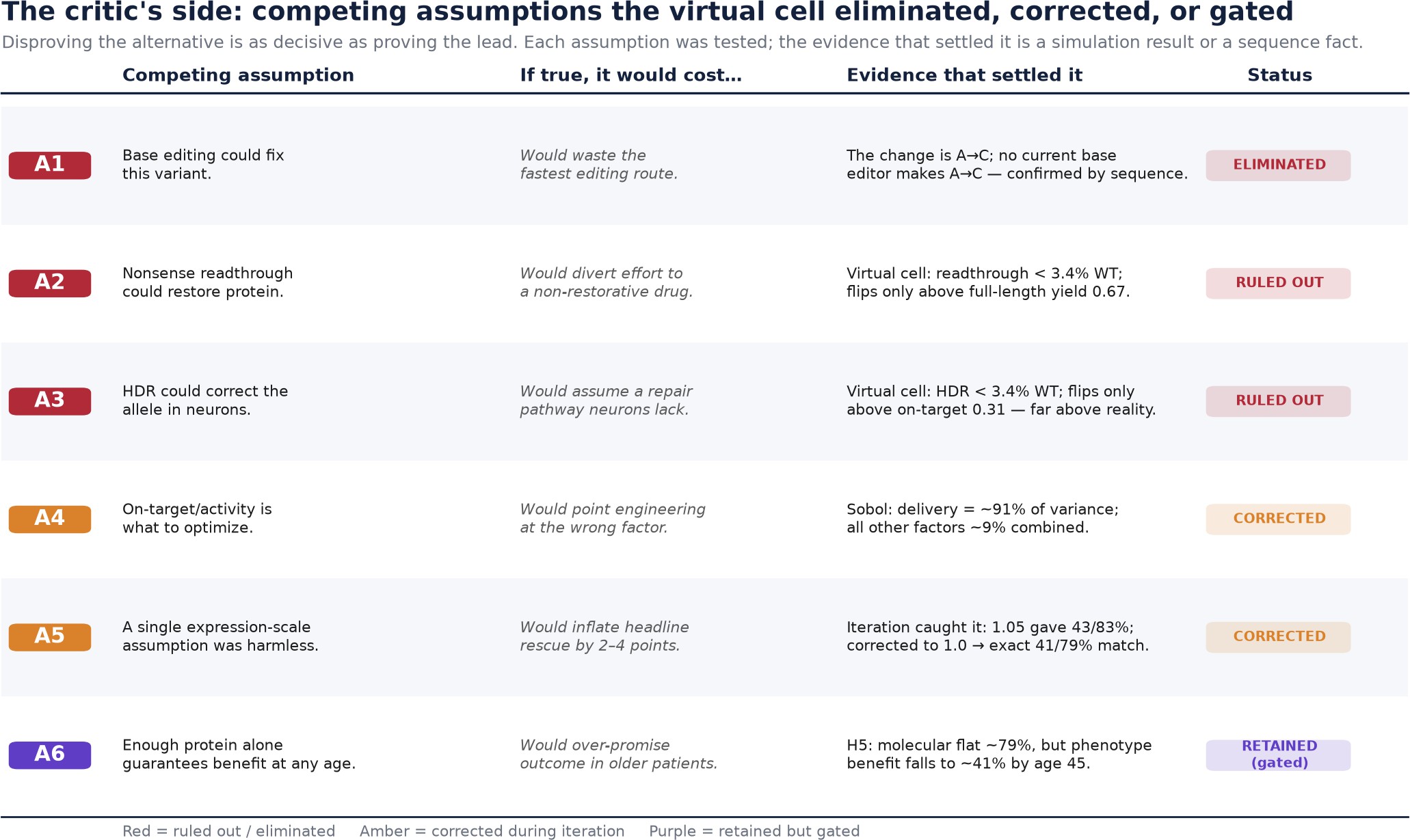
Six competing assumptions were put to the model and disproved on the same evidence: base editing can't make the required A→C change; readthrough and HDR stay under 3.4%; on-target efficiency is not the thing to optimize for the lead (delivery dominates); a "harmless" 1.05 expression multiplier was caught inflating the headline during iteration; and protein alone does not guarantee benefit at any age (timing gates it). Disproving each alternative is what makes the surviving plan defensible.
Where the virtual cell becomes a program, not a paper
A calibrated virtual cell and a ranked set of hypotheses is a research artifact; a treated child needs two more things. First, a multidisciplinary review: a specialist panel reads the same case brief from six disciplines — medical genetics, gene-therapy engineering, pediatric neurology, delivery/vectorology, biostatistics, and family navigation — each attaching its conditions (delivery unproven at scale; protein overshoot needs monitoring; off-targets must be measured), captured as structured data that becomes the program's risk register. Second, the Navigator rewrites that consensus as a roadmap a family can walk: a one-sentence headline, sequenced next steps, checkpoints, questions for the care team, and logistics — already drafted here as a one-page At-a-Glance card and a jargon-free Plain-Language Guide.
Why this matters
The bottleneck in rare-disease gene therapy is that the grounding, simulation, verification, and translation work in front of the human experts consumes the scarcest time in the field — and doesn't scale. The virtual-cell cycle changes that: it replaces argument with simulation (run each strategy on the same calibrated cell and read a ranked answer with failure reasons); it names the one thing that matters per modality (delivery for gene reintroduction, on-target rate for prime editing), so the hardest engineering is aimed correctly from day one; it is defensible by construction (reduces exactly to a checkable closed-form model, every input traces to a live database, an independent model corroborates, and it updates automatically when real data arrives); and it closes the loop to the family. The point is not that AI decides gene therapy — it is that the mechanical-but-hard work of model, simulate, iterate, rank, corroborate, and translate can be done reliably, traceably, and fast, so human expertise is spent where it uniquely matters.